
Breaking Barriers: How Women are Shaping the Future of Cell & Gene Therapy
Building on the findings from our International Women's Day "Breaking Barriers" infographic, we're continuing this critical conversation with the depth it deserves. The CGT Circle and Biocair present a more nuanced exploration of women's experiences in cell and gene therapy, bringing statistical findings to life through the real voices of survey respondents and industry leaders. This ongoing dialogue reflects our commitment to addressing gender equity as an everyday priority, not just an annual observance.
The Leadership Challenge
The promise of cell and gene therapy to revolutionise medicine hinges on more than scientific breakthroughs.
It depends on who leads those breakthroughs.
Diverse leadership drives innovation, challenges conventional thinking, and ensures treatments serve diverse populations. Yet as our field races toward clinical applications, a critical gap has emerged between the ambitions of the women in our field and the opportunities to lead.
Women across the CGT ecosystem aren't just ready to lead, they're eager to reimagine what leadership means. They envision leadership built on inspiration rather than authority, strategic vision rather than status, and inclusive cultures rather than hierarchical power.
But to realise this vision, we must first understand what stands in their way.As one respondent powerfully shared:
“Throughout my career I have watched male counterparts get more opportunities than me and I have felt I had to work much harder to achieve the same level of success.”
This conclusion? The barriers women face aren't primarily about capability or commitment—they're about visibility, both of the path forward and of themselves as potential leaders.
Redefining Leadership and Breaking Through Barriers
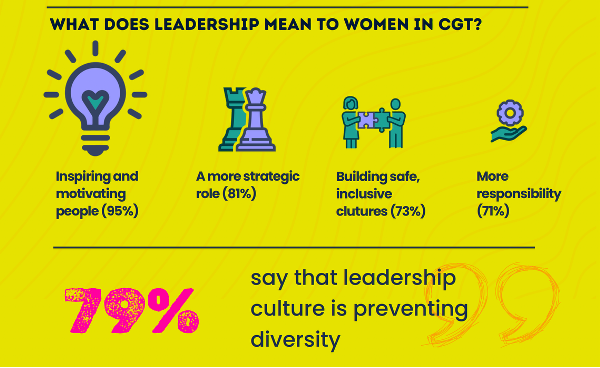
When asked what leadership means to them, women in CGT offered a profound reimagining of power and influence. Far from focusing on traditional metrics of success like compensation or team size, they emphasised the transformative aspects of leadership.
The overwhelming focus on inspiring others, building inclusive cultures, and strategic influence suggests women see leadership not as a position to attain but as an opportunity to transform. This perspective offers our field something invaluable; leadership centred on long-term impact rather than short-term gains.
“As part of a global company, we speak with colleagues in different continents, countries and cultures every day, often without knowing what their experience is like. Setting time aside to get to know our colleagues and their challenges helps us to cultivate a culture built on empathy, compassion and understanding.”
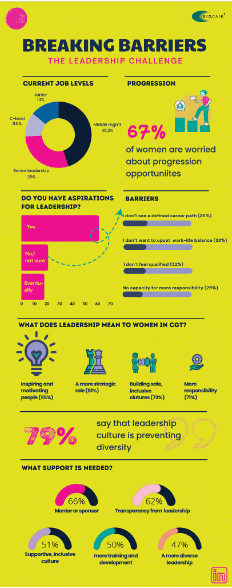
Our survey reveals that 94.5% of women identified "inspiring and motivating people" as a key component of leadership, while 81% valued having "a more strategic role" in their organisations, and 73% emphasised "building safe, inclusive cultures." These statistics highlight a leadership vision that extends far beyond traditional notions of authority and compensation.
Culture emerged as the overwhelming factor holding women back from leadership in CGT. But what does this mean in daily work life?
The culture barrier manifests in subtle ways.
For example, the meeting where women's ideas are overlooked until repeated by male colleagues; the high-visibility projects assigned through informal networks; the differing standards for what constitutes ‘executive presence’ or ‘leadership material’.
This highlights why diversity initiatives focused solely on hiring often fail to change leadership composition. The cultural environment must transform to value and develop talent equitably throughout the organisation.
“Employee resource groups are one way to begin to shift the culture of a company. The formation of these groups starts with identifying the need or desire to strengthen a particular group within an organisation, and then connecting members of this group as a resource to each other.
By ensuring the group is truly open to everyone in the organisation, and receiving buy-in and participation from people of varying backgrounds and perspectives, we are able to have constructive conversations.”
Confidence, Support, and the Path Forward
Among the reasons women hesitate to pursue leadership, feeling discouraged about career prospects emerged as a significant factor. This isn't simply about individual confidence – it reflects organisational systems that often fail to provide women with accurate feedback about their readiness for advancement.
As one respondent poignantly shared: "During my training, the opinions of female leaders who were discouraged and tired of pursuing leadership goals impacted me deeply. Some wished they had studied different careers or hoped their children wouldn't pursue a Biology degree or a PhD." Member, The CGT Circle
This sentiment reveals a key insight. What appears as a confidence gap often reflects women's accurate reading of different standards applied to their behaviour. Addressing this requires not just encouraging women to step forward, but ensuring they'll be evaluated fairly when they do.
When asked what would help them advance, women in CGT identified personalised support through mentorship and sponsorship as their top need. This reveals a crucial understanding: technical excellence alone isn't enough to navigate complex organisational landscapes.
The distinction between mentorship (guidance and advice) and sponsorship (active advocacy and opportunity creation) emerged clearly in our findings. While mentorship provides valuable development, sponsorship – having influential leaders who actively champion your advancement – proves transformative.
Our survey showed that 66% of women indicated a mentor or sponsor as their most needed form of support, while 62% wanted more honesty and transparency from leadership. This data underscores that addressing systemic barriers requires both individual development and organisational change.
It’s evident that individual effort alone cannot overcome systemic barriers. Women need allies in positions of influence who recognise their potential and actively create pathways for their advancement.
Marie Howell of Biocair notes the power of connection in addressing these challenges:
“On the individual level, we are seeing that connection through employee resource groups mitigates feelings of isolation. It also opens the door to resources to help the individual manage a challenge they may be facing, including opportunities for mentorship and sponsorship.”
Building the Pipeline: From Education to Industry
The journey to leadership begins long before entering the workforce. Our findings reveal that most women in CGT today pursued their careers despite limited encouragement.
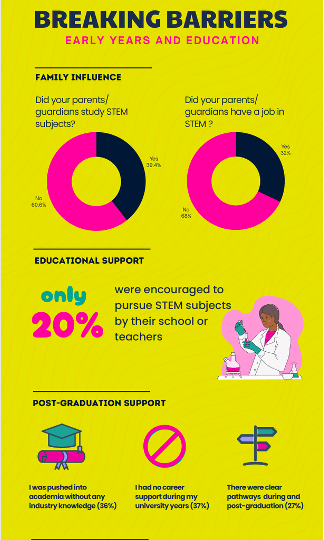
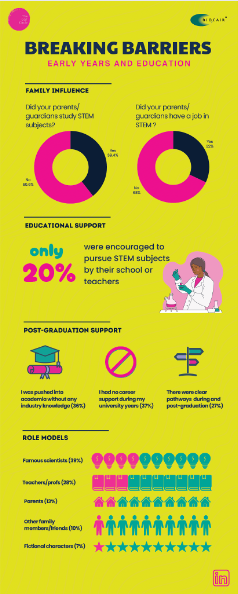
Only 20% reported being actively encouraged by educators to pursue STEM subjects.
One respondent reflected on her educational journey: "Coming from an economic and socially privileged background, I was always supported in my interest in STEM as a woman. The doors were open for me, but equally I was aware of the inequalities in access to STEM in other communities... This experience helped me understand that often the lack of women in STEM comes from social norms and pressures, but also from a lack of education in the opportunities available to them. A lack of encouragement that they can excel in STEM fields."
This highlights how narrow conceptions of scientific aptitude often filter out diverse thinkers who bring exactly the fresh perspectives needed for innovation. By actively addressing unconscious biases and expanding our vision of what a ‘promising scientist’ looks like, we can capture talent currently slipping through the cracks.
Role models shape aspirations in powerful ways. Interestingly, our survey revealed that women found inspiration from diverse sources including famous scientists, teachers, family members, and even fictional characters.
A personal favourite was Dana Scully!
This diversity of influence highlights an important truth: representation matters in all spheres of life. When young women see scientists who look like them in textbooks, media, and real life, they can more easily envision themselves in those roles.
As we say often at The CGT Circle, “You cannot be what you cannot see.”
Famous scientists were cited a lot and while celebrating renowned scientists remains important, creating opportunities for direct interaction between young women and relatable STEM professionals may have even greater impact. Teachers could play a critical role here.
The transition from education to career emerges as a critical leak in the talent pipeline. With only 27% of respondents reporting clear career pathways during and after graduation, we're losing talented women at precisely the moment they should be entering the field.
This disconnect between academic training and industry opportunities particularly affects women, who often have less access to informal networks where job opportunities circulate.
One respondent shared her experience: "As neither of my parents were in academia, I think I was a bit lost in my early university years. I think for other students with parents in academia, finding internships or knowing what career steps to take was a bit easier.” Member, The CGT Circle.
Creating structured pathways between educational institutions and industry could be another way to help retain talented women who might otherwise leave STEM fields entirely.
From Insights to Action
Collectively, these insights point to clear opportunities for accelerating women's leadership in cell and gene therapy. The challenges are systemic, but they're not insurmountable.
With culture identified as the primary barrier, organisations must move beyond superficial diversity initiatives to examine how everyday practices advantage some groups while disadvantaging others.
Promising practices include:
Structured interview processes
Transparent promotion criteria
Regular culture audits that specifically examine how systems impact different demographic groups
Sponsorship over mentor programs
Formal mentorship programs provide valuable guidance, but sponsorship, where influential leaders actively create opportunities and advocate for women, proves transformative.
"Effective sponsorship isn't just about giving advice, it's about using your power to create pathways," notes Rikke Hogg. "Leverage personal relationships to gather momentum. Engage key stakeholders throughout the organisation to gather interest. Have open conversations about real challenges."
Organisations seeing the greatest progress have implemented structured sponsorship programs that pair promising women with senior leaders and include accountability measures for both parties.
The finding that many women don't see defined career paths highlights the need for transparent advancement routes, including non-traditional paths that accommodate different life stages and priorities.
“I’ve built a career by walking into rooms I technically didn’t belong, and every time, someone held the door open, before I even crossed the threshold.”
Flexibility in career progression, including part-time leadership roles, job sharing at senior levels, and re-entry programs after career breaks, helps retain women who might otherwise leave during key life transitions.
With only 20% of respondents having been encouraged by educators to pursue STEM, early intervention emerges as crucial for building the future talent pipeline.
Industry-education partnerships that include curriculum input, teacher training, and direct student engagement show the greatest promise for expanding and diversifying the talent pipeline. Organisations like the STEMettes, STEM Cymru, Engineering UK, the British Council's Women in STEM scholarships and the newly developed T-levels in the UK are all implementing programs and pathways to work towards parity and achieve this goal.
Building Tomorrow Together
Perhaps the most important conclusion is that women in CGT shouldn't have to navigate these challenges in isolation. The barriers are systemic, not individual, and require collective action.
The CGT Circle, with support from Biocair, is committed to driving collective action, including:
Establish best practices for inclusive and equitable hiring practices, retention, and advancement practices
Expand educational outreach to inspire the next generation of women in CGT, including apprenticeships, mentoring enablement and more
Create a leadership development program specifically designed for women in CGT
This short-term action plays into a longer-term vision for parity and diversity across our field. We envision a future with environments that recognise, nurture, and elevate women's leadership potential.
The future of cell and gene therapy depends on harnessing the full spectrum of talent and perspective. By addressing these insights, we can build a more innovative, inclusive, and ultimately more successful industry.
To learn more about The CGT Circle's International Women's Day initiatives or to get involved in our ongoing work to support women in cell and gene therapy, get in touch.
This article was developed in partnership between The CGT Circle and Biocair, with special thanks to the 145 women who shared their experiences and insights through our survey.
About Biocair
Since 1986, Biocair has established a global reputation as a leading GDP logistics specialist within the pharmaceutical, biotechnology and life sciences sectors. Biocair has built up a unique, client-centric approach by employing scientists in front-line logistics positions and assembling a team of best-in-class industry experts in quality, cold chain and regulatory compliance.
Biocair employs 475 people worldwide and provides specialist logistics services to more than 170 countries through a global network of partners. Biocair’s offices are located in the UK, France, Belgium, Germany, USA, South Africa, China and India.
For further information on Biocair, please visit www.biocair.com.
About The CGT Circle
The CGT Circle is a dynamic network empowering women in cell and gene therapy through community-led connections. Founded on the belief that meaningful relationships drive professional success, we create welcoming spaces where women across the entire cell and gene therapy ecosystem can forge lasting friendships, share experiences, and support each other's growth.
Our approach is uniquely local yet globally minded. We understand that the most powerful connections often happen close to home, which is why we enable regional networks across the UK, Europe, and USA. These local chapters are created by the community, for the community, ensuring each gathering reflects the needs and character of its members.
Join us in our mission to harness the collective power of women in cell and gene therapy. Together, we're not just building networks. We're creating a community where women in CGT can thrive.