
How Do We Treat More Patients?
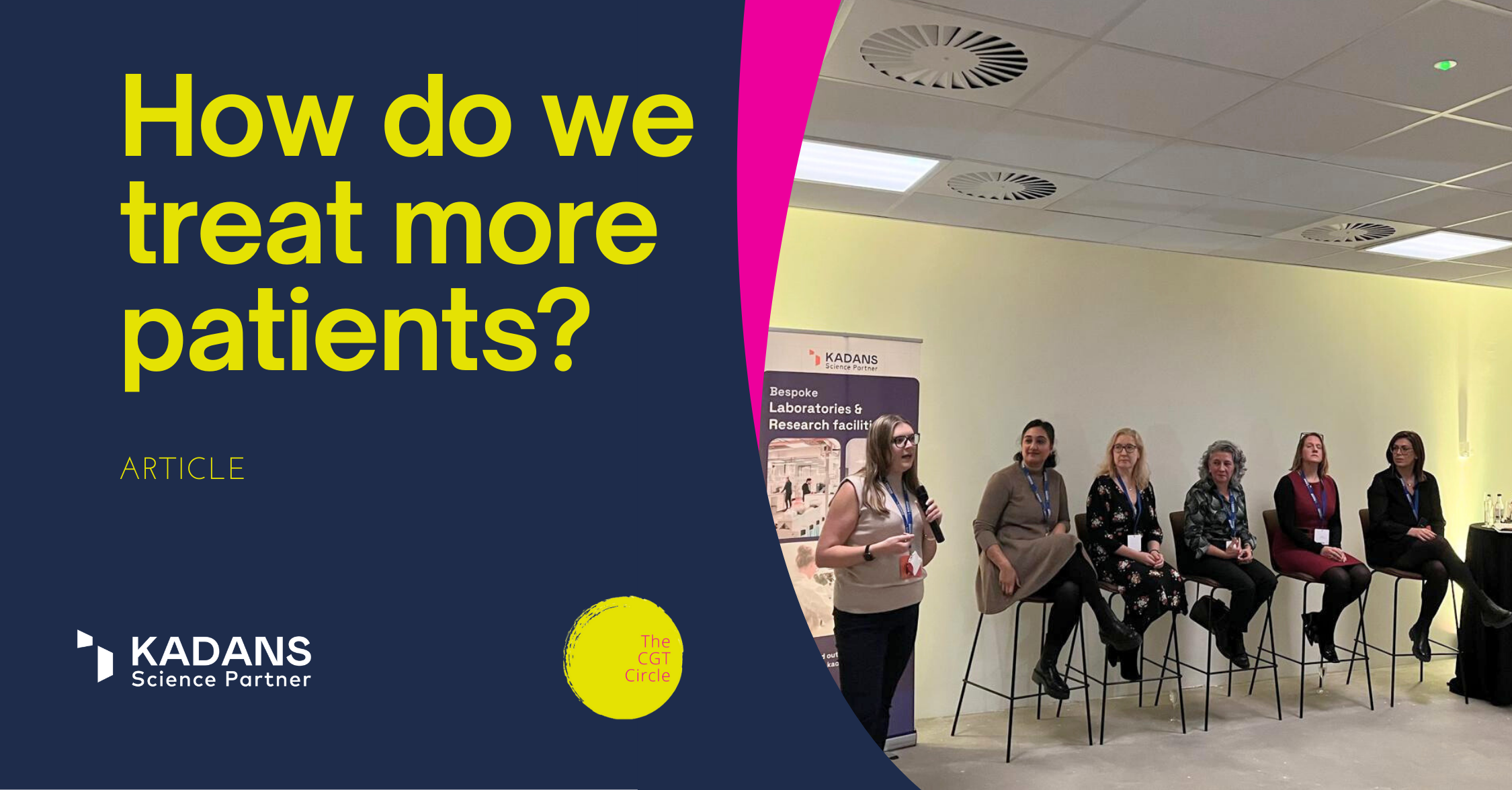
A reflection on the barriers to patient access in cell and gene therapy and what we're doing about them - we review some hard truths from Kadan’s CGT Circle Panel
Last Thursday evening at the new Kadans' facility near King’s cross, I had the privilege of moderating a panel discussion that asked a deceptively simple question: How do we treat more patients?
The question is anything but simple.
It's broad, complex, and deeply nuanced. But it's also the question that keeps everyone in cell and gene therapy up at night.
I was joined by four brilliant women from different corners of the CGT ecosystem: Diana HERNANDEZ from Anthony Nolan, Lilian Hook from NHS Blood and Transplant, Terri Gaskell, CTO at Riniri Therapeutics, and Neelam Panchal, PhD from the Cell and Gene Therapy Catapult.
What unfolded over the next hour was an honest conversation about the very real barriers standing between breakthrough science and the patients who desperately need it.
Here are the big talking points we’ll explore further in this article:
Infrastructure: the unsexy bottleneck costing lives
The process is product: doctrine or dogma?
Capital: an existential threat to innovation
Decentralised manufacturing: realistic or romantic?
First-line treatment: not always the right goal
Patient engagement: still an afterthought
Women in leadership
1. Infrastructure: The Unsexy Bottleneck That's Costing Lives
When we talk about barriers to patient access, the conversation often gravitates toward pricing, regulation, or manufacturing costs. But the panellists were unanimous on something far more fundamental: we don't have enough apheresis capacity.
Lilian Hook laid it out plainly. NHSBT operates eight apheresis units performing approximately half of all UK procedures and while they're expanding with additional beds, any significant new funding is unlikely. Diana Hernandes shared that Anthony Nolan recently opened a new four-bed apheresis center in Nottingham specifically to address this bottleneck.
The reality? We're losing patients before treatment even starts, not because the therapies don't exist, not because they haven't been approved, but because we simply can't collect their cells.
It's not glamorous. It won't make headlines. But it's the truth.
Beyond apheresis, there's the question of cell processing lab capacity, ICU bed availability, and the practical challenges patients face, e.g., travel distance to treatment centers, time off work, coordinating logistics across multiple facilities.
Despite regulatory approvals and proven efficacy, patients still cannot access therapies due to logistical and financial constraints that have nothing to do with the science.
If we can't fix these infrastructure basics, does it matter how innovative our therapies are?
2. "The Process is the Product" is Holding Us Back
This one sparked the most debate.
The "process is product" dogma has been ingrained in the CGT field for years. The idea is that because these therapies are so complex and individualised, every step of the manufacturing process must be locked down and unchangeable.
But Terri Gaskell challenged this directly: it's outdated, and it's preventing us from scaling.
Consider this…when you're moving from 12 doses for first-in-human trials to 30,000 doses for commercialisation, you need to optimise your process. But current regulatory thinking makes that extraordinarily difficult.
The panel advocated for a shift from process adherence to product characterisation. If you have robust potency assays and can demonstrate your product meets specifications, why does it matter if you've made process improvements?
Organisations like ISSCR are developing roadmaps for standardisation, but the panellists were clear.
Regulators need to drive this, not just respond to it.
We need regulatory flexibility on process changes, standardisation of common assays, and a more pragmatic approach that doesn't treat every process tweak as a catastrophic deviation.
The current system, as Diana noted, forces companies to audit and qualify everything separately, even when existing accreditations like JACIE should be sufficient. It's bureaucracy masquerading as rigour.
Neelam Panchal didn't mince her words. The lack of capital is actively harming our ability to innovate toward more accessible therapies.
The UK has strong early-stage innovation and IP, but what it lacks is growth capital, i.e., the funding that takes promising therapies from proof-of-concept to commercial viability.
The challenge is complicated by lessons from first-generation CGTs. These pioneering products faced unprecedented hurdles, not because the science failed, but because introducing cutting-edge medicines requires transforming entire healthcare systems, not just proving efficacy.
Some early products didn't deliver anticipated returns, teaching both companies and investors critical lessons about timelines, costs, and market readiness. The result? Investors now want to see clinical data, not just pre-clinical promise, and are exploring faster paths to validation, including trials in China.
We’ve seen a wave of big pharma exiting too. Novartis, GSK, AstraZeneca, companies that might have been natural acquirers for UK biotech, have pulled back because cell and gene therapy doesn't fit their business models.
The impact of these factors is that UK companies are struggling to raise growth capital and facing exits to the US or China just when they should be scaling up.
One panellist framed it as a challenge to the industry: we must demonstrate that these therapies are life-changing AND can reach mainstream adoption. We need to restore investor confidence through results, not just promises.
No amount of scientific brilliance matters if we can't fund the journey from lab to patient.
4. Decentralised Manufacturing: Promising Idea or Romantic Nostalgia?
The conversation around manufacturing models revealed just how product-dependent the answer is.
For autologous CAR-T therapies, decentralised models might make sense. NHSBT already runs a successful decentralised model for stem cell transplants, performing 5,000 procedures annually. We know it can work.
For allogeneic products, it’s obvious that centralised manufacturing is likely more appropriate. They are more standardised products that can be shipped to multiple sites.
We discussed Galapagos too, a sad tale for what seemed like a beacon of light in the decentralised space. They nearly achieved viable decentralised CAR-T manufacturing, but regulatory challenges across different regions proved insurmountable.
But in terms of hospital-based manufacturing, it’s not just about the GMP facility itself. It's about ensuring adequate ICU beds, pharmacy liquid nitrogen storage, and trained staff distributed geographically. You can't just drop a manufacturing unit into a hospital and expect it to work.
The nuance here matters. There's no one-size-fits-all answer. Product type, indication, patient population, and regulatory landscape all factor into whether decentralisation makes sense.
I asked about moving CGTs from late-line to first-line treatment, which seems like a no brainer in terms of patient benefit.
The panel's response surprised me. First-line positioning isn't always appropriate or desirable.
Terri gave the example of gene therapies for sickle cell disease. Yes, they're potentially curative, but they also involve unpleasant myeloablative conditioning. For younger patients, red cell exchange might be preferable until they're older and can better tolerate the therapy.
The decision depends on:
What alternative treatments are available
How invasive the therapy is
The risk-benefit calculation for different patient populations
Long-term safety data (which requires 10+ years to establish)
Cost and accessibility
The insight: We need to stop assuming that "earlier is always better" and instead ask "what's right for THIS patient at THIS point in their disease journey?"
6. We're Building Therapies Without Asking Patients What They Actually Want
This one should be shouted from the rooftops!
Lilian and Terri both emphasised that we must engage patients early in development to understand what quality-of-life changes actually justify the risks of therapy. Not after the fact.
Patient-reported outcomes should be collected before and after treatment, not just retrospectively as an afterthought. Clinical endpoints must also reflect patient priorities.
The example given for hearing loss therapies was that, resolution matters more to patients than volume but trials might measure the wrong thing if developers aren't listening to what patients actually care about.
As one panellist put it: "We can't just decide what's important from our ivory tower and then go out and treat patients accordingly."
So, how do we build patient engagement into the development process from day one, not as a box-ticking exercise but as a fundamental driver of trial design?
Back to CGT Circle Basics
I closed the panel with a question about women navigating leadership in this sector. The room leaned in for this one.
The consensus? There's no pipeline problem. The talent exists; the panel (and this lot) prove it.
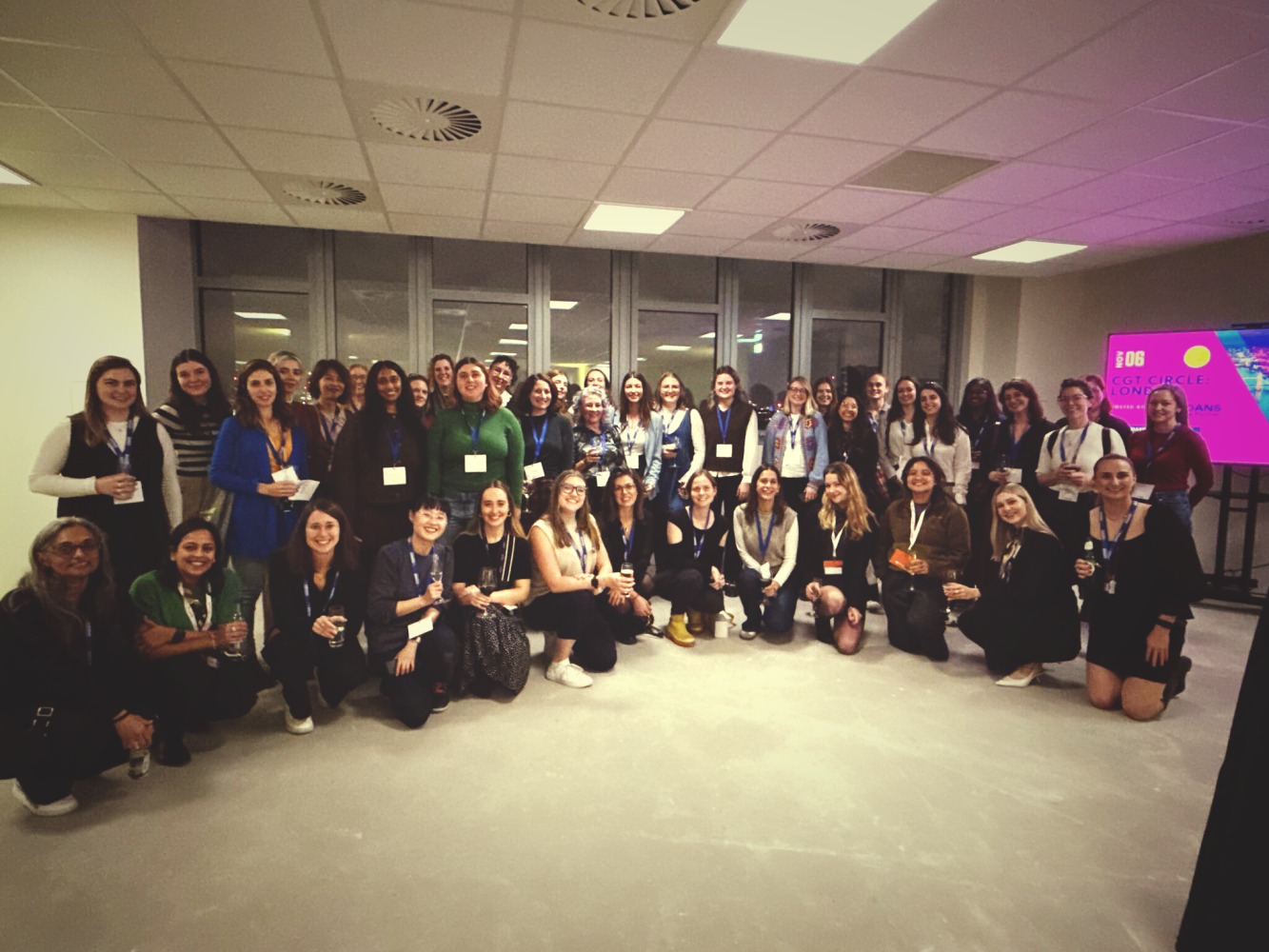
Group shot of the fabulous crowd at the Kadans CGT Circle!
What the panel offered was practical advice about operating in male-dominated spaces:
Stop apologising. "Don't apologise before you even start," Terri said. "Don't try and make yourself small to make everyone else more comfortable."
Be your own advocate. As Diana put it bluntly: "You have to be your best advocate and your strongest advocate at all times. Don't ever be shy about shouting about how well you're doing. Nobody else will shout for you."
Deliver with confidence. Neelam emphasised the importance of how you show up: "If you deliver it with confidence and you deliver it with, like, I have earned my space in this room and I have the seat at the table, then you're going to have some sort of different reception."
The advice: take up space, claim your seat at the table, and stop waiting for someone else to advocate for you.
And crucially, this isn't separate from the patient access question. It's central to it. Diverse leadership teams make different decisions about which patient populations to serve, how to price therapies, and where to invest in access infrastructure.
Finally, the panellists left us with a challenge: in an environment of adversity, we need to leverage collaboration and creative solutions rather than retreating to what's comfortable.
That's what The CGT Circle is about: creating space for these honest, sometimes difficult conversations. Not the polished conference panel. Not the carefully crafted keynote. But the real talk that moves the field forward.
About The CGT Circle
The CGT Circle is a dynamic network empowering women in cell and gene therapy through community-led connections. Founded on the belief that meaningful relationships drive professional success, we create welcoming spaces where women across the entire cell and gene therapy ecosystem can forge lasting friendships, share experiences, and support each other's growth.
Our approach is uniquely local yet globally minded. We understand that the most powerful connections often happen close to home, which is why we enable regional networks across the UK, Europe, and USA. These local chapters are created by the community, for the community, ensuring each gathering reflects the needs and character of its members.
Join us in our mission to harness the collective power of women in cell and gene therapy. Together, we're not just building networks. We're creating a community where women in CGT can thrive.
A special thanks to Katie Nelson, Aisling Yeomans, and Ellena Regan at Kadans Science Partner for hosting this event at their Stevenage facility and to our incredible panellists for their candour and insight.